Case Study: Macquarie: Straight Lines, Circular Vision
The Problem
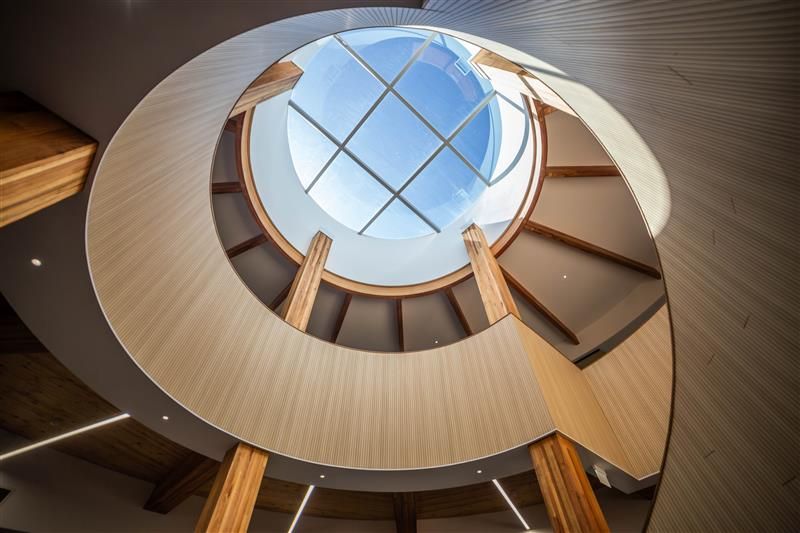
Mass timber structures are almost always designed on a grid: straight lines, repeating bays, predictable spans. The Seniors Building at Macquarie College isn’t built that way. Its centrepiece is a circular oculus, and the broader building reads as curved and organic. So how do you build a radial mass timber structure when the industry defaults to orthogonal grids?
The site made it harder. Land in the surrounding Glendale suburbs had experienced significant ground movement caused by old underground mines in recent years. The structure had to be designed to meet subsidence parameters directly.
On the civil side, building over an existing open, permeable area meant stormwater that previously soaked into the ground now needed to go somewhere – but where the tank could sit was restricted by existing stormwater infrastructure that had to remain, a legal easement running around the building footprint, and the architectural design itself. The existing stormwater system was already overloaded and failing to meet demand, requiring new infrastructure to bypass it entirely.
Uphill of the site, a large oval with rock close to the surface meant significant volumes of groundwater had to be accounted for and designed around.
The soil was highly reactive. Multi-tiered and curved retaining walls were needed across several parts of the site — both a structural requirement and a design feature in their own right. Retaining walls were needed across several parts of the site. Separately from the main building, a 280KL fire hydrant storage tank and pump room had to be built on site, with fire truck access factored into the surrounding carpark layout.
What Birzulis Did
Structural
The building looks circular but is actually facetted – flat glazing panels and precast concrete sections arranged in a ring. Birzulis used the corner points where those flat panels meet as reference positions for the glulam timber beams, setting them out like compass bearings radiating from the centre of the oculus – north, south, east, west, and every bearing between.
The cross-laminated timber floor and roof panels spanned across those beams in matching facets, following the same geometry as the facade. Slab spans and fire rating performance were checked and confirmed throughout. Given the history of ground movement in the area, mine subsidence was carefully addressed through the structural detailing.
Creating a building that reads as curved using predominantly straight structural materials requires design finesse and close attention to detail.
Civil
The civil scope covered the following:
- Stormwater management design
- External pavement works
- Retaining wall design
- Soil erosion and sediment control
- Bulk earthworks
- Early works civil design
- Foundation and slab for the fire hydrant infrastructure.
The OSD (on-site detention) tank couldn’t be a standard shape. Three things dictated its geometry:
- Existing stormwater pipes that had to stay in place
- A legal easement around the building perimeter
- The building’s own footprint.
Working within all three, Birzulis designed the tank with a unique shape that still achieved the detention volume required – and held up against the architect’s design expectations for the space.
Buried pipes had their own problem. The ground in the Glendale area is prone to movement from mine subsidence, putting stress on anything rigid underground. Flexible swivel joints and protective lagging were specified around all stormwater pipes to absorb that movement without cracking or displacing the drainage system.
Across the site, multi-tiered and curved retaining walls were carefully designed and detailed — functioning as both a structural solution and a considered design feature within the landscape.
Away from the main building, a separate 280KL fire hydrant storage tank and pump room also required engineering. Birzulis designed the foundation and slab for that structure, coordinated the services running through it with other consultants, and worked through a modification to the adjacent carpark – the existing layout was tight, requiring swept path checks and detailed set-out of kerbs and gutters to ensure fire appliances could adequately access the hydrant tank, turn, and exit safely.
How It Turned Out
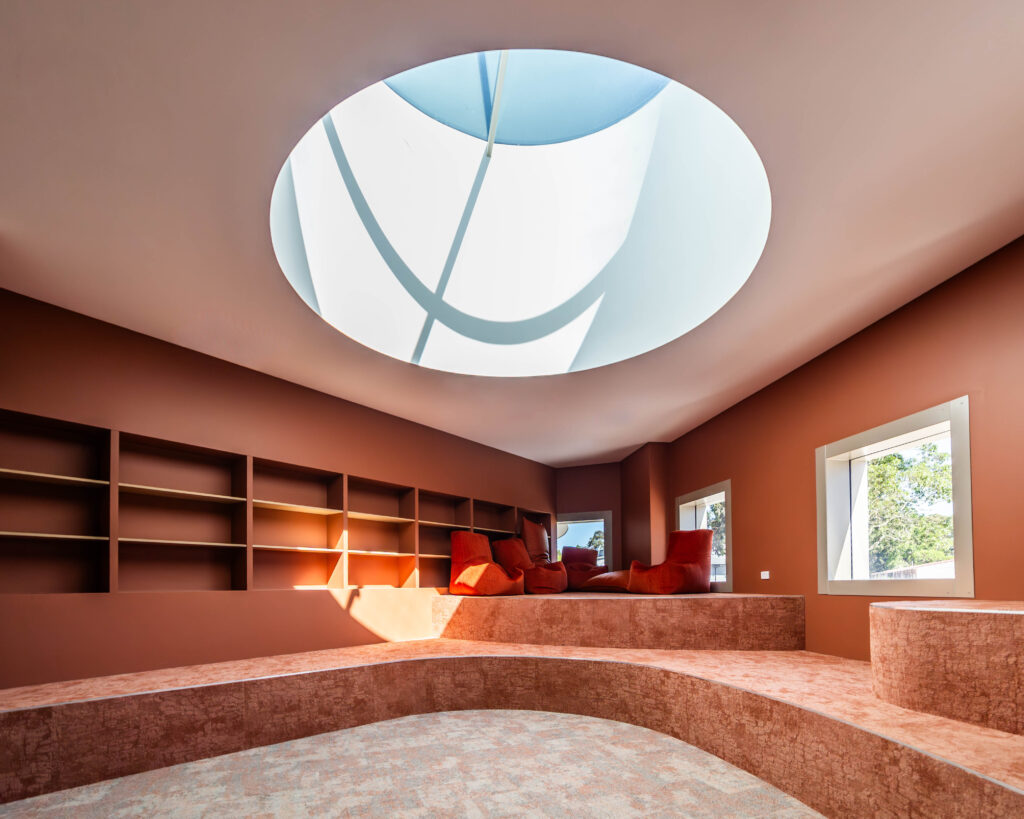
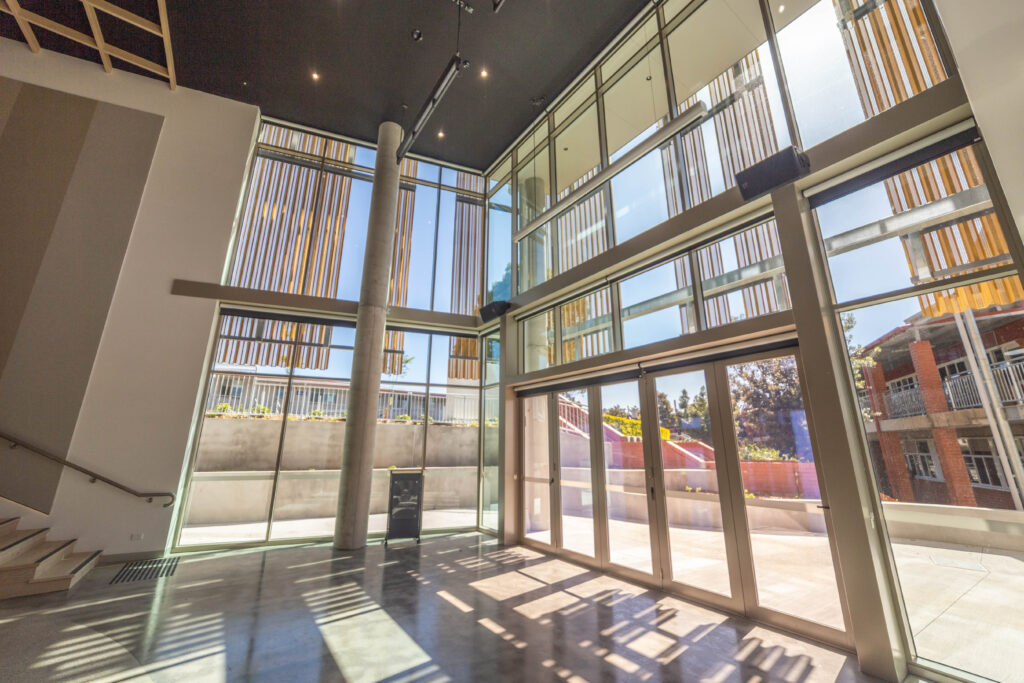
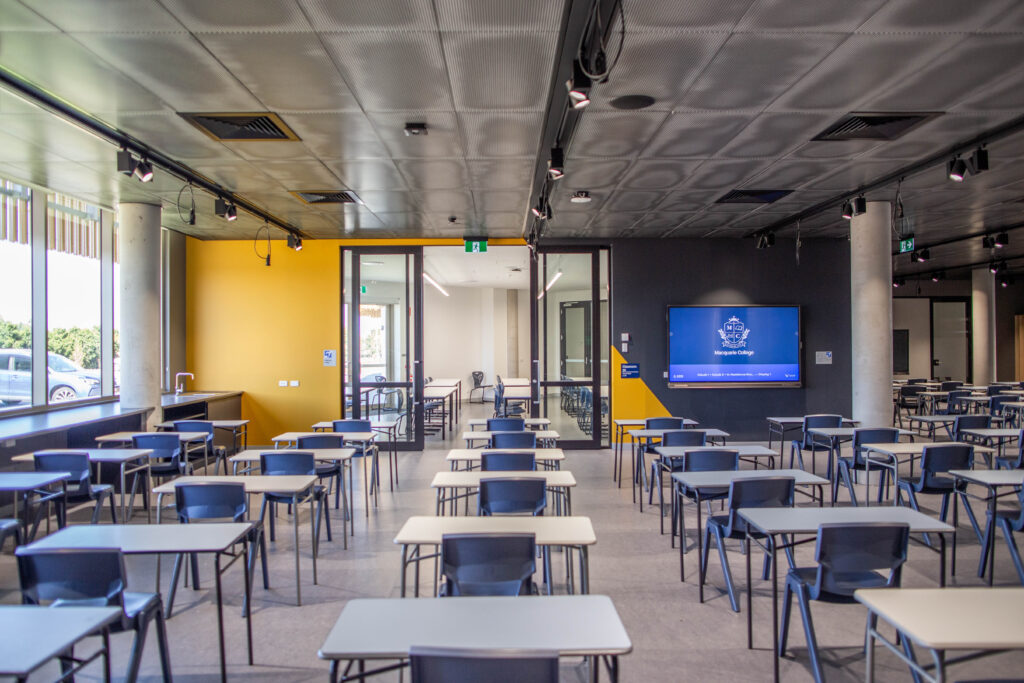
The building now serves Macquarie College’s senior students with a library and amphitheatre, 10 classrooms, a design lab, café, staff facilities, breakout rooms, and outdoor learning areas.
Through efficient structural design, Birzulis kept the steel reinforcement content per square metre well below what’s typically expected for a building of this scale and value without compromising structural performance. The design was optimised from the outset, using exactly what the structure needed. Mass timber also brought a sustainability benefit: lower embodied carbon than conventional structural materials.
It looks like curved, organic architecture. It’s built from flat panels and straight beams, precisely arranged. Getting there takes more than technical knowledge. It takes the kind of judgement that only comes with experience and the finesse Birzulis brought to this project.